 IPST – International Private School of Technology


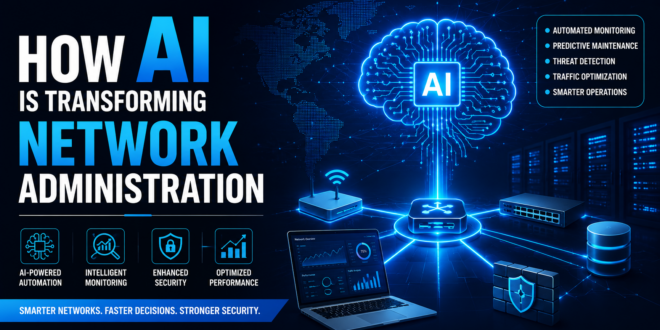
📅 June 2026 | 🌐 Networking | 🤖 Artificial Intelligence | ⏱️ 5 min read
🚀 The Rise of AI-Powered Networks
Artificial Intelligence is rapidly transforming the way modern networks are designed, monitored, and maintained. Traditional network administration often requires significant manual effort to identify issues, optimize performance, and secure infrastructure.
Today, AI-powered solutions are enabling network administrators to automate repetitive tasks, predict failures before they occur, and improve overall network reliability.
As organizations continue adopting cloud computing, IoT devices, and hybrid work environments, AI is becoming a critical component of modern network operations.
🧠 How AI Enhances Network Management
Artificial Intelligence analyzes vast amounts of network data in real time, allowing administrators to make faster and more informed decisions.
Key AI Capabilities:
✅ Automated network monitoring
✅ Predictive maintenance
✅ Intelligent traffic analysis
✅ Automated troubleshooting
✅ Security threat detection
✅ Capacity planning and optimization
These capabilities significantly reduce operational complexity while improving network performance.
⚡ Automated Network Monitoring
AI-powered monitoring systems continuously analyze network traffic, device health, and performance metrics.
Benefits
🔹 Detect anomalies instantly
🔹 Reduce downtime
🔹 Improve response times
🔹 Generate automated alerts
🔹 Minimize manual supervision
Instead of waiting for users to report issues, AI can proactively identify problems before they impact business operations.
🔍 Predictive Maintenance
One of the most valuable applications of AI is predictive maintenance.
By analyzing historical data and device behavior, AI systems can forecast potential failures and recommend preventive actions.
Examples
📡 Access Point performance degradation
🖥️ Server resource exhaustion
🔌 Switch hardware failures
🌐 WAN link instability
🔋 UPS battery health monitoring
This approach helps organizations avoid costly outages and service interruptions.
🛡️ AI-Powered Network Security
Cybersecurity threats continue to evolve at an unprecedented rate. AI enhances security by detecting unusual patterns that may indicate malicious activity.
AI Security Functions
🚨 Intrusion Detection
🚨 Malware Identification
🚨 Behavioral Analysis
🚨 Anomaly Detection
🚨 Threat Intelligence Correlation
AI can analyze millions of events per second, providing a level of visibility impossible through manual monitoring alone.
📊 Intelligent Traffic Optimization
AI helps optimize bandwidth utilization and network performance by analyzing traffic patterns in real time.
Advantages
📈 Better user experience
📈 Reduced congestion
📈 Improved application performance
📈 Dynamic bandwidth allocation
📈 Enhanced Quality of Service (QoS)
Organizations can deliver more reliable connectivity while maximizing available resources.
🏢 Real-World Applications
Many leading technology companies have already integrated AI into their networking solutions.
Examples
🔹 Cisco AI Network Analytics
🔹 Juniper Mist AI
🔹 HPE Aruba Central AI Insights
🔹 Microsoft Intelligent Network Monitoring
🔹 Google Cloud Network Intelligence
These platforms help IT teams manage increasingly complex infrastructures with greater efficiency.
📈 Business Impact
| Benefit | Impact |
|---|---|
| Faster Troubleshooting | 🔥 High |
| Reduced Downtime | 🔥 High |
| Improved Security | 🔥 High |
| Lower Operational Costs | ⚡ Medium |
| Better User Experience | 🔥 High |
| Predictive Maintenance | ⚡ Medium |
Organizations adopting AI-driven networking technologies often experience improved operational efficiency and stronger network resilience.
🔮 The Future of Network Administration
The future of networking will increasingly rely on AI-driven automation. Network administrators will spend less time on repetitive tasks and more time focusing on strategic initiatives, architecture design, and cybersecurity.
As AI technologies continue to mature, autonomous networks capable of self-monitoring, self-healing, and self-optimization are expected to become the industry standard.