 IPST – International Private School of Technology


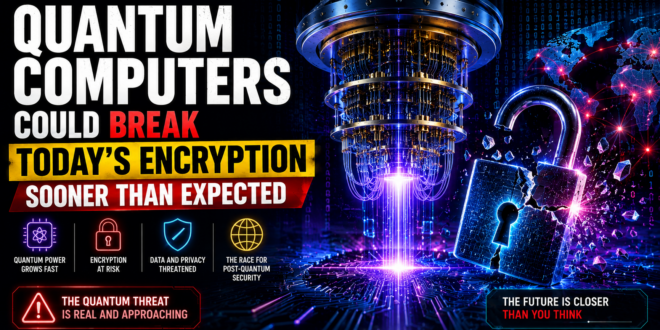
📅 June 2026 | 🔐 Cybersecurity | ⚛️ Quantum Computing | 🌐 Technology | ⏱️ 6 min read
⚠️ A New Threat on the Horizon
For decades, modern encryption has protected everything from online banking and cloud services to government communications and corporate networks.
However, cybersecurity experts are increasingly warning that the rise of quantum computing could fundamentally change digital security as we know it.
While today’s encryption methods remain secure against traditional computers, future quantum systems may possess the power to break some of the world’s most widely used cryptographic algorithms.
⚛️ What Is Quantum Computing?
Quantum computing is a revolutionary technology that processes information using quantum bits, known as qubits.
Unlike traditional computers that use binary values (0 and 1), quantum computers can perform multiple calculations simultaneously.
Key Advantages
🚀 Massive Processing Power
🚀 Complex Problem Solving
🚀 Faster Mathematical Calculations
🚀 Advanced Scientific Research
🚀 Artificial Intelligence Acceleration
These capabilities could unlock incredible innovations—but also introduce significant cybersecurity risks.
🔓 Why Encryption Could Be at Risk
Most of today’s internet security relies on cryptographic systems that are difficult for traditional computers to break.
Quantum computers could dramatically reduce the time needed to solve certain mathematical problems used in encryption.
Potentially Impacted Technologies
🔐 RSA Encryption
🔐 Public Key Infrastructure (PKI)
🔐 Digital Certificates
🔐 Secure Email Systems
🔐 VPN Technologies
🔐 Financial Security Platforms
This has led governments and technology companies to accelerate research into quantum-resistant security solutions.
🛡️ The Race for Post-Quantum Cryptography
Cybersecurity researchers are already preparing for the quantum era.
Emerging Solutions
✅ Quantum-Resistant Algorithms
✅ Post-Quantum Cryptography (PQC)
✅ Advanced Key Management
✅ Hybrid Encryption Systems
✅ Future Security Standards
The goal is to protect sensitive information before large-scale quantum computers become a practical reality.
🌍 Industries Most Affected
Certain sectors may face greater risks than others.
High-Risk Industries
🏦 Banking & Finance
🏥 Healthcare
🏛️ Government Agencies
☁️ Cloud Providers
📡 Telecommunications
⚡ Critical Infrastructure
Organizations in these sectors are already evaluating future cryptographic migration strategies.
🤖 Quantum Computing and AI
Quantum technology could also significantly accelerate artificial intelligence development.
Potential Benefits
🧠 Faster AI Training
🧠 Improved Machine Learning Models
🧠 Advanced Simulations
🧠 Scientific Discovery
🧠 Drug Development
The same computing power that enables innovation may also challenge current cybersecurity protections.
📊 Security Impact Assessment
| Technology Area | Quantum Risk Level |
|---|---|
| RSA Encryption | 🔴 Critical |
| Digital Certificates | 🔴 Critical |
| VPN Infrastructure | 🟠 High |
| Cloud Security | 🟠 High |
| Financial Systems | 🔴 Critical |
| Post-Quantum Cryptography | 🟢 Low |
Security experts recommend preparing long before quantum threats become operational.
🏢 How Organizations Can Prepare
Recommended Actions
✅ Inventory Cryptographic Assets
✅ Monitor Post-Quantum Standards
✅ Update Security Roadmaps
✅ Implement Crypto Agility
✅ Evaluate Quantum-Resistant Solutions
✅ Train Security Teams
Preparation today can significantly reduce future migration challenges.
🔮 Looking Ahead
Although practical large-scale quantum computers capable of breaking modern encryption are not yet widely available, progress in the field continues to accelerate.
Governments, technology companies, and cybersecurity organizations are investing billions of dollars into quantum research and post-quantum security initiatives.
The transition to quantum-resistant cryptography may become one of the most important cybersecurity projects of the coming decade.
The question is no longer if organizations should prepare for the quantum era—but when.