 IPST – International Private School of Technology


📅 June 2026 | 🤖 Artificial Intelligence | 💰 Technology Investment | 🌐 Global Infrastructure | ⏱️ 6 min read
🚀 The AI Race Enters a New Era
The global race for Artificial Intelligence dominance is accelerating at an unprecedented pace.
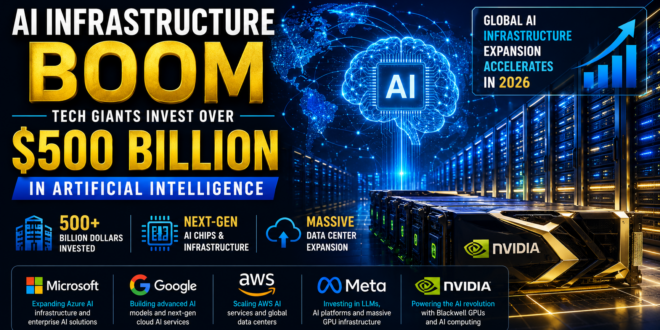
In 2026, leading technology companies including Microsoft, Google, Amazon, Meta, and NVIDIA are collectively investing more than $500 billion into AI infrastructure, data centers, advanced processors, cloud computing platforms, and next-generation AI systems.
These massive investments are reshaping the technological landscape and laying the foundation for the future of artificial intelligence.
💰 Why Are Companies Investing So Much?
Artificial Intelligence has become one of the most strategic technologies of the decade.
Organizations worldwide are rapidly adopting AI-powered solutions for automation, cybersecurity, healthcare, finance, education, and software development.
Key Drivers
✅ Growing demand for AI services
✅ Expansion of cloud computing
✅ Development of AI Agents
✅ Increasing enterprise adoption
✅ Global competition for AI leadership
✅ Demand for high-performance computing
Technology leaders view AI as the next major industrial revolution.
🏢 The Biggest Investors in AI
Several technology giants are leading the AI infrastructure expansion.
Microsoft
🔹 Expansion of Azure AI infrastructure
🔹 Integration of AI across enterprise services
🔹 Large-scale data center investments
🔹 Development of advanced AI models
🔹 Expansion of cloud AI services
🔹 Next-generation TPU deployment
Amazon
🔹 AWS AI infrastructure growth
🔹 Enterprise AI services
🔹 Data center expansion projects
Meta
🔹 AI-powered social platforms
🔹 Large Language Model development
🔹 Massive GPU infrastructure deployment
NVIDIA
🔹 Blackwell AI processors
🔹 High-performance AI computing
🔹 Global AI hardware leadership
🖥️ The Rise of AI Data Centers
The backbone of modern AI is computing power.
Around the world, technology companies are building next-generation AI data centers capable of supporting billions of AI requests every day.
Data Center Innovations
⚡ High-density GPU clusters
⚡ Advanced cooling systems
⚡ Renewable energy integration
⚡ High-speed networking
⚡ AI-optimized architecture
These facilities are becoming critical assets in the global AI ecosystem.
🌐 Impact on Businesses
The rapid expansion of AI infrastructure is expected to benefit organizations across every industry.
Business Advantages
📈 Faster AI adoption
📈 Improved productivity
📈 Reduced operational costs
📈 Better automation
📈 Enhanced customer experiences
📈 Smarter business decisions
Companies that successfully leverage AI technologies are expected to gain significant competitive advantages.
🤖 AI Agents Drive Infrastructure Demand
One of the biggest factors behind the AI infrastructure boom is the rise of AI Agents.
Unlike traditional AI systems, AI Agents can perform complex tasks, automate workflows, analyze information, and interact with software autonomously.
AI Agent Applications
🔹 Customer Support
🔹 Cybersecurity Operations
🔹 Software Development
🔹 Network Administration
🔹 Business Analytics
🔹 Digital Marketing
As adoption grows, demand for computing resources continues to increase.
📊 Industry Outlook
| Sector | Growth Potential |
|---|---|
| Artificial Intelligence | 🚀 Very High |
| Cloud Computing | 🚀 Very High |
| Data Centers | 🔥 High |
| Cybersecurity | 🔥 High |
| Enterprise Software | 🔥 High |
| Network Infrastructure | 🔥 High |
Analysts predict continued growth throughout the remainder of the decade.
🔮 The Future of AI Infrastructure
Experts believe the current wave of investment is only the beginning.
Future developments are expected to include:
🌍 Larger AI data centers
⚡ More powerful AI processors
🤖 Advanced autonomous AI systems
☁️ Expanded cloud AI services
🔐 Stronger AI cybersecurity platforms
📡 Smarter global digital infrastructure
The organizations investing today are positioning themselves to lead the next generation of technological innovation.