 IPST – International Private School of Technology


Introduction
Artificial Intelligence (AI) is a branch of computer science that focuses on creating machines and software capable of performing tasks that usually require human intelligence. These tasks include learning, problem-solving, decision-making, language understanding, and recognizing images or speech.
What Is Artificial Intelligence?
Artificial Intelligence enables computers to analyze data, recognize patterns, and make decisions. Instead of following only fixed instructions, AI systems can improve their performance by learning from experience. Two important branches of AI are:
- Machine Learning (ML): Computers learn from data without being explicitly programmed for every task.
- Deep Learning (DL): A specialized form of machine learning that uses artificial neural networks to solve complex problems.
Applications of Artificial Intelligence
Artificial Intelligence is used in many areas of everyday life, including:
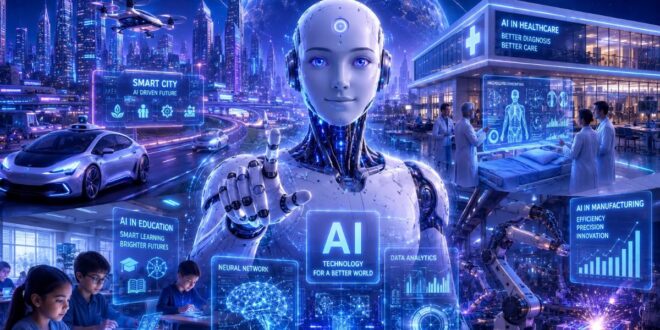
- Healthcare: Assisting doctors in diagnosing diseases and analyzing medical images.
- Education: Providing personalized learning experiences and intelligent tutoring systems.
- Transportation: Supporting self-driving vehicles and improving traffic management.
- Business: Automating customer service and analyzing large amounts of data.
- Entertainment: Recommending movies, music, and videos based on users’ interests.
Advantages of Artificial Intelligence
AI offers many benefits, including:
- Increasing productivity and efficiency.
- Reducing human errors.
- Performing repetitive tasks quickly and accurately.
- Supporting better decision-making through data analysis.
- Improving healthcare, education, and scientific research.
Challenges of Artificial Intelligence
Although AI has many advantages, it also presents several challenges:
- Automation may replace certain jobs.
- AI systems can produce biased results if trained on biased data.
- Privacy and data security remain important concerns.
- Ethical issues arise when AI is used to make significant decisions.
The Future of Artificial Intelligence
Artificial Intelligence is expected to become even more advanced in the future. It will continue to transform industries such as healthcare, education, agriculture, transportation, and manufacturing. As AI evolves, it is essential to develop and use it responsibly to ensure it benefits society while respecting ethical standards.
Conclusion
Artificial Intelligence is one of the most important technological innovations of the 21st century. It has the potential to improve people’s lives, solve complex global challenges, and create new opportunities across many fields. By encouraging responsible development and ethical use, society can maximize the benefits of AI while minimizing its risks.