 IPST – International Private School of Technology


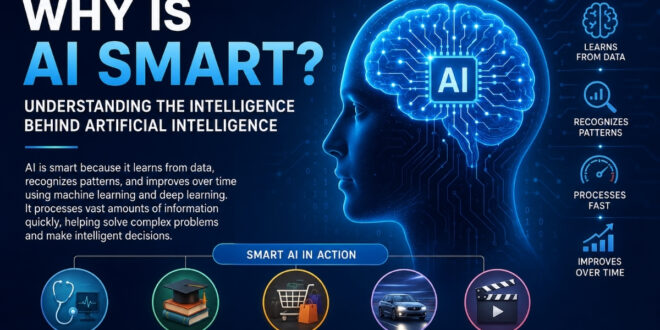
Artificial intelligence (AI) has transformed the way people work, learn, and communicate. From virtual assistants to self-driving cars, AI systems are becoming more capable every year. But many people still ask the same question: Why is AI smart?
The answer lies in a combination of powerful algorithms, massive amounts of data, and advanced computing technology. In this article, we’ll explain why AI is considered smart, how it learns, and why it continues to improve.
What Is Artificial Intelligence?
Artificial intelligence is a branch of computer science that enables machines to perform tasks that normally require human intelligence. These tasks include:
- Recognizing images and speech
- Understanding natural language
- Solving problems
- Making predictions
- Learning from experience
Unlike traditional software that follows fixed rules, AI can adapt its behavior by analyzing data and identifying patterns.
Why Is AI Smart?
AI is smart because it can process huge amounts of information, recognize complex patterns, and improve its performance through learning. Instead of relying only on pre-programmed instructions, modern AI systems use machine learning and deep learning techniques to make increasingly accurate decisions.
Here are the main reasons why AI appears intelligent.
1. AI Learns From Data
One of the biggest reasons AI is smart is its ability to learn from data. Every time an AI model analyzes new information, it becomes better at recognizing patterns and making predictions.
For example:
- Email filters learn to detect spam.
- Streaming services recommend movies based on viewing history.
- Online stores suggest products based on shopping behavior.
The more high-quality data AI receives, the better it generally performs.
2. AI Recognizes Patterns Quickly
Humans are excellent at creativity and reasoning, but AI excels at analyzing enormous datasets in seconds.
For instance, AI can:
- Detect diseases from medical images.
- Identify fraudulent financial transactions.
- Analyze weather patterns.
- Recognize faces in photographs.
This pattern recognition makes AI extremely valuable across many industries.
3. AI Uses Machine Learning
Machine learning is one of the core technologies behind AI.
Instead of programmers writing every possible rule, machine learning algorithms discover patterns by studying examples. As more examples become available, the model improves its accuracy.
This ability to continuously learn is one reason AI is considered smart.
4. Deep Learning Mimics Neural Networks
Deep learning is a specialized type of machine learning inspired by the structure of the human brain.
Artificial neural networks process information through multiple layers, allowing AI to understand:
- Images
- Videos
- Speech
- Written language
This technology powers many of today’s most advanced AI applications.
5. AI Processes Information at Incredible Speed
Computers can perform billions of calculations every second.
Because of this speed, AI can analyze information much faster than humans, making it useful for:
- Scientific research
- Financial analysis
- Cybersecurity
- Manufacturing
- Logistics
Speed alone doesn’t create intelligence, but it allows AI to solve problems efficiently.
Can AI Think Like Humans?
Although AI is impressive, it does not think or understand the world exactly like humans.
Current AI systems:
- Learn from data rather than life experiences.
- Do not possess consciousness.
- Do not have emotions.
- Lack genuine self-awareness.
Instead, AI predicts the most likely answer or action based on patterns it learned during training.
Real-World Examples of Smart AI
AI is already helping millions of people every day.
Some common examples include:
Healthcare
AI assists doctors by analyzing medical scans, predicting diseases, and supporting treatment decisions.
Education
Educational platforms use AI to personalize learning experiences and recommend study materials.
Business
Companies use AI to automate customer service, analyze market trends, and improve productivity.
Transportation
Navigation systems calculate the fastest routes, while advanced driver-assistance features improve road safety.
Entertainment
Music and video platforms recommend personalized content based on user preferences.
Advantages of Smart AI
The growing intelligence of AI offers many benefits, including:
- Faster decision-making
- Increased productivity
- Improved accuracy
- Automation of repetitive tasks
- Better customer experiences
- Enhanced scientific research
- Support for innovation across industries
As AI continues to evolve, these advantages are expected to grow.
Challenges of Artificial Intelligence
Despite its strengths, AI also faces important challenges.
These include:
- Data privacy concerns
- Algorithmic bias
- Security risks
- Lack of transparency in some models
- Ethical considerations
- Potential impacts on employment
Responsible development and human oversight remain essential for ensuring AI benefits society.
The Future of AI
Artificial intelligence is advancing rapidly. Future AI systems are expected to become more capable in areas such as healthcare, robotics, education, climate research, and scientific discovery.
Researchers are also working to make AI more reliable, transparent, and aligned with human values. While AI will likely become even more powerful, human creativity, judgment, empathy, and ethical decision-making will continue to play a critical role.
Frequently Asked Questions
Why is AI smarter than traditional software?
Traditional software follows predefined instructions, while AI learns from data and adapts to new situations, making it more flexible and capable.
Can AI become smarter over time?
Yes. AI models can improve as they receive more high-quality data, better training methods, and advances in computing power.
Does AI have emotions?
No. AI can recognize and respond to emotional cues, but it does not experience emotions or feelings.
Is AI replacing humans?
AI is more often used to assist people by automating repetitive tasks. Many jobs are changing, but human expertise, creativity, and critical thinking remain essential.
Conclusion
So, why is AI smart? The answer lies in its ability to learn from massive amounts of data, recognize patterns, improve through machine learning, and process information at extraordinary speed. While AI is not conscious or human-like in its understanding, it has become an incredibly powerful tool that is transforming industries worldwide.
As artificial intelligence continues to evolve, understanding how it works will help individuals and businesses use this technology more effectively and responsibly.